
Introduction
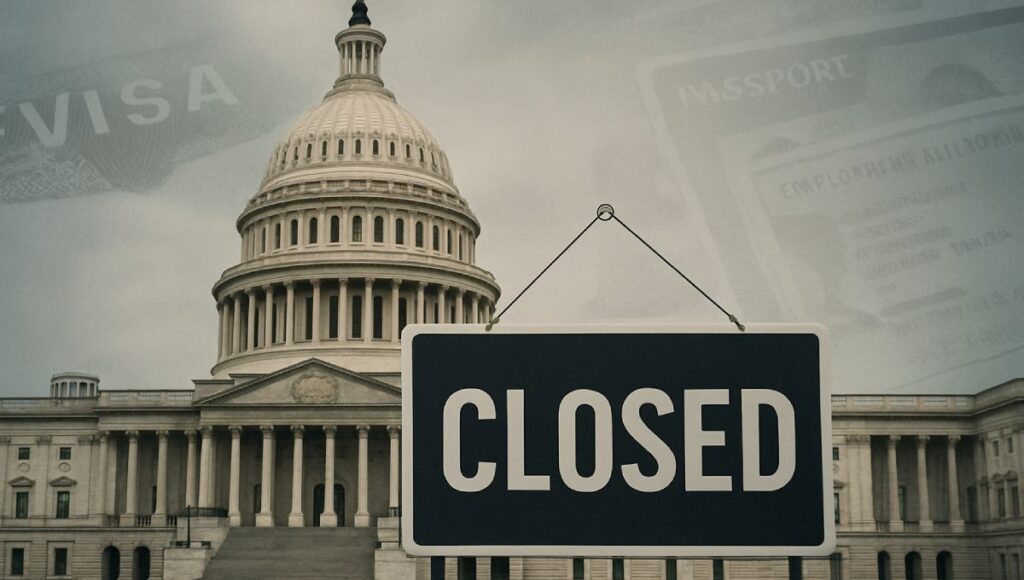
On October 1, 2025, at 12:01 a.m. (ET), the United States entered a partial government shutdown after Congress failed to enact a funding bill. Under the Anti deficiency Act, federal agencies without independent fee funding must suspend operations. While several immigration-related functions continue, the Department of Labor (DOL)—a critical player in employment-based immigration—has ceased operations.
1. Agencies Directly Impacted by the Shutdown
Department of Labor (DOL) – Complete Suspension of Services
- The Office of Foreign Labor Certification (OFLC) is closed.
- The Foreign Labor Application Gateway (FLAG) system is inaccessible.
- No processing of the following applications can occur:
- Labor Condition Applications (LCAs) for H-1B, H-1B1, and E-3 visas.
- PERM labor certification applications (Form ETA-9089).
- Prevailing Wage Determinations (PWDs) (Form ETA-9141).
- Audit responses and appeals before the Board of Alien Labor Certification Appeals (BALCA).
Legal consequence: Employers cannot file new H-1B or E-3 petitions requiring an LCA and cannot move forward with PERM-based green card cases until DOL operations resume. Any filing deadlines falling during the shutdown period are tolled, but employers must document the interruption carefully.
E-Verify – Unavailable
- The E-Verify system is offline. Employers cannot create new cases or resolve existing Tentative Non-Confirmations (TNCs).
- During prior shutdowns, DHS provided flexibility by suspending the three-day rule for E-Verify cases until the system was restored. Similar accommodations are expected.
Executive Office for Immigration Review (EOIR) – Immigration Courts
- Non-detained hearings (for individuals not in custody) are postponed.
- Detained hearings proceed because they are classified as “essential.”
- Filings for non-detained cases may be suspended, creating delays and docket backlogs.
2. Agencies Continuing Operations
U.S. Citizenship and Immigration Services (USCIS)
- USCIS remains largely unaffected because it is funded primarily by filing fees rather than congressional appropriations.
- Adjudications continue for petitions and applications, including:
- H-1B (if an LCA is already certified)
- L-1, O-1, P-1, TN
- Employment-based immigrant petitions (EB-1, EB-2 NIW)
- Family-based petitions
- Adjustment of status and naturalization applications
- However, USCIS programs dependent on appropriations—such as E-Verify and certain humanitarian categories—remain suspended.
U.S. Department of State (DOS)
- Visa and passport services generally continue because they are fee-funded.
- U.S. embassies and consulates abroad remain open, subject to staffing and resource constraints.
- If the shutdown persists for an extended period, DOS may reduce non-essential visa services.
U.S. Customs and Border Protection (CBP)
- Ports of entry, inspections, and border enforcement remain fully operational because they are considered essential functions.
- Delays are possible due to reduced support staff, but international travel and admission into the U.S. will continue.
Student and Exchange Visitor Program (SEVP / SEVIS)
- The SEVIS system remains functional, allowing schools and students to maintain status updates, transfers, and extensions.
- F-1, J-1, and M-1 students may continue to file petitions with USCIS as usual.
3. Case-Specific Impacts
H-1B and E-3 Petitions
- New petitions requiring LCAs cannot be filed until DOL reopens.
- Extensions and amendments may proceed if the LCA was already certified.
- Employers must maintain evidence of the shutdown’s impact—screenshots of the FLAG outage, official DOL shutdown notices, and internal correspondence showing attempts to comply.
Practice Note: Historically, USCIS has accepted late H-1B filings if petitioners can show the inability to obtain a timely LCA was due to a government shutdown.
PERM Labor Certification (EB-2 and EB-3 Cases)
- No PERM applications or prevailing wage requests can be filed or processed.
- Cases with expiring recruitment periods or deadlines must be carefully documented.
- Employers should preserve evidence that the shutdown prevented filing; once operations resume, filings should be submitted immediately.
Cases Not Dependent on DOL
- L-1, O-1, P-1, TN, EB-1, National Interest Waiver (NIW), family-based petitions, asylum, TPS, and adjustment of status remain unaffected by the shutdown.
- Employers and applicants should continue filing these petitions to avoid unnecessary delays.
4. Recommended Employer and Applicant Actions
- File Immediately if Possible
- If you already have a certified LCA, do not delay in filing the petition with USCIS.
- Submit any filings not dependent on DOL to avoid a future backlog.
- Document the Shutdown Impact
- Retain evidence of system unavailability (screenshots, official notices).
- Keep records of deadlines that fell during the shutdown.
- Prepare cover letters explaining that late filings were due to extraordinary circumstances beyond your control.
- Communicate with Employees
- Notify affected foreign nationals of potential delays.
- Reassure employees in categories unaffected by DOL that their cases remain on track.
- Prepare for Post-Shutdown Backlogs
- Historically, once DOL reopens, a surge of filings creates processing delays.
- Employers should be prepared for slower adjudication of LCAs, prevailing wage determinations, and PERM applications.
- Monitor Congressional Developments
- Past shutdowns have lasted anywhere from a single day to 35 days (2018–2019).
- The duration of this shutdown remains uncertain; employers must remain flexible and alert.
5. Conclusion
The 2025 government shutdown has created immediate disruption for DOL-dependent immigration processes—most notably H-1B, E-3, and PERM filings. Employers and employees must act strategically: file where possible, document delays, and prepare for backlogs once operations resume.
While USCIS, DOS, CBP, and SEVIS continue to operate, the inability to file LCAs and PERMs creates a critical bottleneck in employment-based immigration. The ultimate impact will depend on the length of the shutdown and whether Congress reaches a resolution promptly.
In the meantime, employers are advised to maintain full compliance, prepare documentation of shutdown-related barriers, and consult immigration counsel for case-specific guidance.


 Immigration Fleet Law Firm