
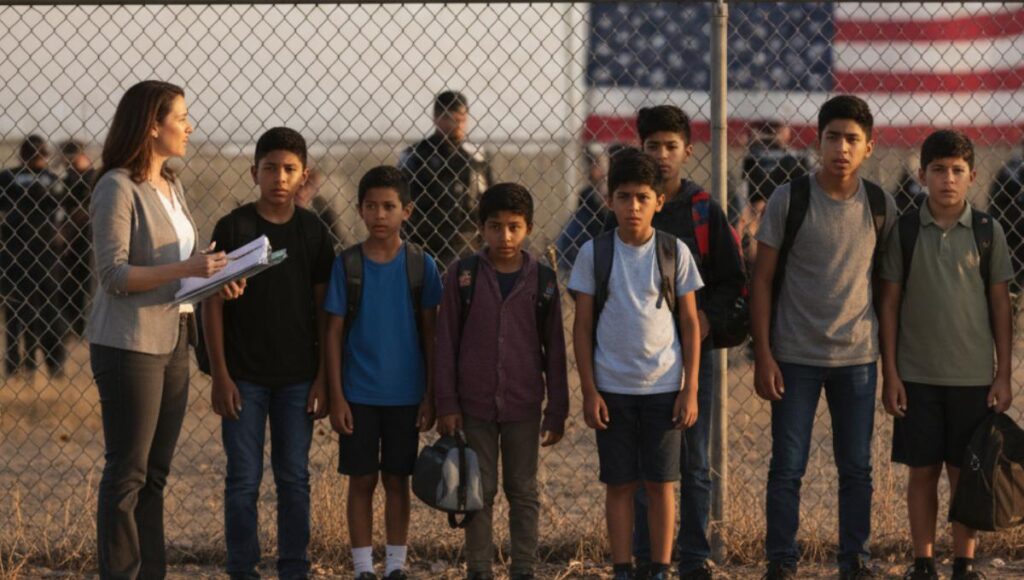
On October 3, 2025, circulating reports from AILA and other trusted legal‑immigration sources indicate that U.S. Immigration and Customs Enforcement (ICE) is launching a new nationwide enforcement initiative, reportedly codenamed “Freaky Friday”, aimed at unaccompanied children (UACs), especially those aged 14 or older, though there are troubling signals that younger children may also be targeted. Given the gravity of these claims, legal practitioners, child advocates, and stakeholders must approach the situation with urgency, strategic planning, and rigorous advocacy.
Below is a detailed legal and strategic framework to understand the possible contours of this operation, the statutory and constitutional constraints, the risks to children, and recommended responses.
Reported Operational Claims (Working Hypotheses)
Because no public ICE confirmation exists as of this writing, all of the following must be treated as intelligence reports or allegations. Each should be verified to the extent possible before assuming it as fact in legal strategy.
- ICE may issue “threat letters” to youth who were previously in UAC (unaccompanied alien child) custody (or released), warning that upon turning 18 (“aging out”), they may be taken into ICE custody unless they waive TVPRA jurisdiction or withdraw pending claims for relief.
- Some letters may contain offers of financial incentives for voluntary return to the child’s country of origin.
- The letters may implicitly or explicitly reference adverse consequences (e.g. sponsor liability or immigration enforcement against family members), though the scope and enforcement of such threats are unverified.
- ICE may attempt to detain former UACs upon aging out, or place them back into custody under ICE supervision.
- The targeting is reportedly focused on older minors (e.g. 14+), though suggestions regarding younger children should be treated as speculative.
- These measures may extend beyond minors currently in custody to those who have already been released.
Because of the high-stakes implications, any advocacy or litigation draft should clearly label unconfirmed elements (e.g. “reportedly,” “allegedly,” or “if implemented”) and avoid definitive statements until corroborated by documents or field reports.
Statutory, Regulatory & Constitutional Constraints
Even if ICE were to seek aggressive enforcement, it must operate within legal guardrails. Below are key constraints and doctrinal considerations.
1. Trafficking Victims Protection Reauthorization Act (TVPRA) & ORR Custody Regime
- TVPRA sets out special protections for unaccompanied children, including transfer of encountered minors generally to HHS/ORR custody, placement with qualified sponsors when available, and screening for trafficking and support services.
- Once minors are released to sponsors, the statutory protections are weaker, but the government does not have a free pass to reclaim or reassert jurisdiction at will.
- Any effort to coerce children to waive TVPRA jurisdiction or withdraw relief may run counter to Congress’s intent to protect minors under TVPRA.
2. Flores Settlement and Minors’ Custody Standards
- Under the Flores Settlement (and related judicial precedents), minors in immigration custody must be placed in safe, licensed facilities, and—when feasible—released to family or sponsors in a timely manner, in the least restrictive setting consistent with safety.
- Any detention or re‑detention of minors must comply with Flores’s requirements and any applicable court orders or consent decrees in the relevant jurisdiction.
- ICE cannot simply abandon or override Flores constraints in the name of enforcement.
3. Age-Out Transfers, Detention, and APA Review (e.g. Garcia Ramirez)
- In Garcia Ramirez v. ICE, the court held that ICE cannot automatically place minors who turn 18 into adult detention without individualized consideration of alternatives.
- Statutory language (8 U.S.C. § 1232(c)(2)(B)) requires ICE, when assuming custody of a former UAC who has “aged out,” to consider placement in the least restrictive setting, taking into account specified risk factors.
- Therefore, any blanket policy transferring aged-out former UACs into secure detention without individualized review is vulnerable to APA challenge (arbitrary and capricious) and likely to be enjoined.
4. Due Process & Coercion Risk
- Children—like all persons subject to U.S. jurisdiction—are protected under the Fifth Amendment’s Due Process Clause, especially when liberty or significant rights are at stake.
- If threat letters or enforcement actions deprive a child (or sponsor) of meaningful notice, access to counsel, or a hearing before adverse consequences, those procedures may violate procedural due process.
- A waiver signed under pressure or threat may be challenged as involuntary or coerced. Courts scrutinize whether a waiver was knowing, voluntary, and free of duress.
5. Administrative Law / APA / Scope of Authority
- A major shift in enforcement policy toward minors—especially requiring waiver signing or automatic detention—may be subject to challenge under the APA, unless ICE can justify the policy as a permissible exercise of enforcement discretion.
- Absent a reasoned explanation, consideration of alternatives, public notice, or internal justification, courts may find the new policy arbitrary, capricious, or beyond ICE’s statutory authority.
- While enforcement discretion generally receives deference, its limits are sharper where it affects vulnerable groups like minors and implicates statutory or constitutional protections.
Key Litigation & Operational Vulnerabilities
If ICE undertakes or attempts to operationalize a “Freaky Friday” initiative, it may face multiple potent legal challenges:
- Invalidation of coerced waivers or forced withdrawals
Any waiver of TVPRA jurisdiction or withdrawal of relief signed under duress or threat (especially without counsel) could be invalidated as involuntary. - Procedural due process defects
Threat letters lacking meaningful time, opportunity to respond, or counsel access may give rise to injunctions. - Violation of Flores and court‑ordered custody regimes
Re‑detaining minors without adherence to Flores, or placing them in overly restrictive settings, can be challenged in court. - Automatic detention of age-outs without review
Blanket transfer to secure detention without individualized assessment would contravene Garcia Ramirez and APA principles. - Arbitrary or capricious enforcement decision‑making
A sudden, sweeping enforcement pivot targeting minors could invite judicial invalidation if not properly justified or reasoned. - Classwide or systemic injunctions
Early litigation may block (or substantially restrain) implementation of the initiative—especially where plaintiffs are minors or UACs. - Political, oversight, and reputational pushback
The sensitive nature of enforcement against minors may provoke congressional scrutiny, media attention, and pressure on ICE and DHS to scale back operations.
Strategic Recommendations & Protective Measures
Given the high stakes and uncertainty, the legal and advocacy community should move along multiple tracks, balancing agility with caution. Below is a calibrated proposal set.
1. Rights Education & Outreach
- Prepare clear, age-appropriate Know Your Rights materials and training for minors in custody or communities, emphasizing do not sign anything without a lawyer.
- Circulate notices to out-of-custody minors—especially those approaching age 18—warning that enforcement letters may arrive and urging them to preserve evidence and promptly consult counsel.
- Engage partner organizations (NGOs, schools, community centers) to spread awareness and direct minors to legal service providers.
2. Monitoring, Evidence & Intelligence Gathering
- File FOIA / ADAP / administrative requests for ICE, DHS, and related interagency documents referencing “Freaky Friday” or designs for minor-targeted enforcement.
- Establish a rapid-report network (attorneys, legal clinics, field advocates) to report in real time on threat letters, ICE visits, or enforcement actions involving minors.
- Upon receipt of any letters or notices, immediately preserve original documents, take photographs, log delivery details (date, time, method, witnesses), and affix affidavits from the child or recipient about how delivery occurred and what was said.
3. Pre-emptive & Defensive Litigation Strategy
- Pre-draft emergency TRO / Preliminary Injunction motion templates, including in jurisdictions with strong immigrant- or child-friendly courts.
- Bring declaratory judgment actions challenging coercive waivers, blanket detention policies, or violation of due process with respect to minors.
- Consider class actions on behalf of similarly situated minors or former UACs to enjoin systemic enforcement practices.
- In individual removal proceedings, raise objections to coerced waivers, assert duress or procedural defects, and preserve the record for appellate or parallel litigation.
4. Sponsor / Guardian Support & Relief Advocacy
- Provide legal counseling and “Know Your Rights” to sponsors, parents, and guardians, so they are better able to resist coercive pressures and understand their rights.
- Assess potential relief options (e.g. prosecutorial discretion, U visas, T visas, adjustment-based paths) that might shield children or family units from enforcement.
- Engage with public interest groups and media to pressure ICE and DHS leadership to limit overreach, particularly in cases involving minors.
5. Oversight, Accountability & Public Pressure
- File oversight complaints with the DHS Office of Inspector General (OIG), DHS Civil Rights & Civil Liberties (CRCL), and relevant Congressional committees, documenting any coercion, threats, or suspected rights violations.
- Coordinate with national advocacy coalitions, child welfare groups, and legal organizations to issue press releases, host briefings, and engage media coverage.
- Use legislative channels (e.g. Friends of the House, Senate Homeland Security / Judiciary Committees) to demand briefings, internal documents, and transparency from DHS, ICE, and related agencies.
Q&A: Legal Tensions & Strategic Issues
Below are advanced legal issues counsel should anticipate:
Q1. If the child is beyond the age of minority, can ICE summarily detain without alternative assessments?
A1. No. Even for “age-outs,” ICE must evaluate less restrictive alternatives before detention. Garcia Ramirez requires individualized assessments. Automatic detention is unlawful.
Q2. Can ICE demand waiver of TVPRA jurisdiction as a condition of avoiding detention or removal?
A2. Not legitimately. Such coercive waivers, especially if signed under duress without counsel, are susceptible to challenge as invalid. TVPRA confers statutory rights that cannot be sacrificed under threat.
Q3. Do children have a constitutional right to counsel before signing withdrawal or waiver documents?
A3. While not guaranteed in all removal proceedings, due process demands meaningful access to counsel when rights are forfeited or waiver is demanded under threat. The coercive context strengthens the case for requiring counsel presence or at least delay until counsel is available.
Q4. If ICE claims this is a child welfare or anti-trafficking operation, can that shield the operation from legal challenge?
A4. Not fully. Courts will examine whether the enforcement is pretextual or overreaching. Statutory child welfare mandates must not be misused to enforce immigration priorities. If the operation is driven by immigration removal rather than child protection, it may face heightened judicial scrutiny.
Q5. Can incentive payments (e.g. $2,500) to induce voluntary return be legally sustained?
A5. Payments may be challenged as undue influence or coercive inducement, particularly when offered to minors under threat. If acceptance is conditioned on surrender of rights or documents waiver, courts may view the inducement as invalid.
Conclusion
If the “Freaky Friday” operation is carried out as reported, it would constitute one of the most sweeping enforcement campaigns ever targeted at vulnerable migrant children and would likely generate waves of litigation, public outcry, and constitutional scrutiny. Legal advocates must act with speed, cohesion, and strategic insight: educating children, filing protective motions, coordinating class or systemic litigation, and marshalling oversight scrutiny.
Time is of the essence. The rights of children under TVPRA, Flores, constitutional due process, and immigration statute demand no less.




 Immigration Fleet Law Firm