
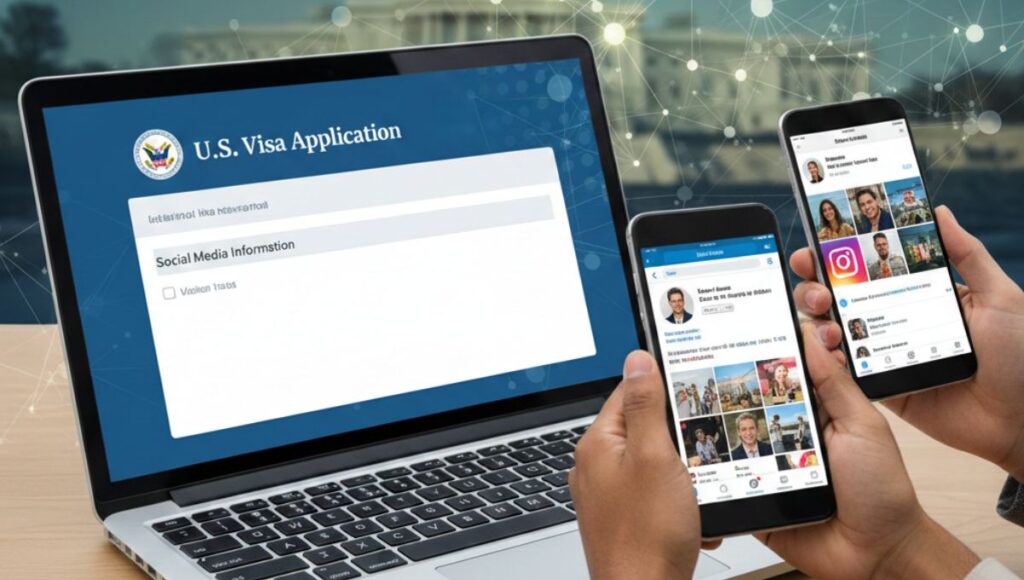
U.S. immigration vetting continues to evolve as federal agencies strengthen national-security and identity-verification measures. One significant development is the expanded requirement for social-media disclosure during the non-immigrant visa application process. This requirement now applies broadly to H-1B specialty occupation workers and their H-4 dependent family members, similar to longstanding practices in student-visa categories such as F-1, M-1, and J-1.
Given the increasing scrutiny associated with consular adjudications, employers and foreign nationals should understand what social-media disclosure involves, how it may affect case processing, and how to prepare in a compliant and transparent manner.
What the Social-Media Screening Requirement Includes
As part of the DS-160 non-immigrant visa application, most applicants must disclose social-media identifiers used within the past several years. U.S. consular authorities may review public-facing content on these platforms as part of the admissibility and security-screening process.
Key points include:
- The requirement applies to H-1B principal applicants and H-4 dependents
- Applicants must list usernames/handles, not passwords
- Public information may be reviewed for identity, security, and fraud concerns
- Incomplete or inaccurate disclosure may delay or adversely affect adjudication
- Private messages are not requested, but public inconsistencies may trigger scrutiny
Social-media review may also be cross-referenced with employment history, immigration filings, and travel records.
Possible Impact on Visa Processing Times
While many cases continue to be processed normally, social-media content that appears inconsistent, misleading, or concerning may result in extended administrative processing. Delays are more likely where:
- Identity verification is unclear
- Immigration-status history appears inconsistent
- Posts contradict employment or education records
- Security-related flags arise
- The applicant previously overstayed or violated status
Employers should plan for the possibility of processing delays when scheduling project deployment or onboarding timelines.
What Applicants Should Prepare Before Visa Filing
To support accuracy and transparency, applicants should ensure that:
- All social-media identifiers are fully and truthfully disclosed
- Employment, education, and immigration history shown online aligns with official records
- Public content does not suggest unlawful activity or misrepresentation
- Dependent family members also provide accurate and complete disclosures
- Accounts remain truthful, professional, and consistent with petition details
Applicants should not delete or alter historical content solely to influence adjudication, as doing so may be viewed as concealment.
Best Practices for Social-Media Compliance and Risk Mitigation
To reduce risk and support transparency:
- Maintain complete and accurate professional profiles
- Avoid inflated job titles or misleading employment details
- Do not discuss unlawful employment or unauthorized work
- Refrain from controversial or threatening statements
- Avoid posting confidential employer information
- Seek legal advice before responding to any security-related inquiry
Consistency across LinkedIn, resumes, petition letters, payroll records, and online presence is particularly important.
Immigration Fleet Law Firm Recommendation
At Immigration Fleet Law Firm, we recommend the following proactive compliance measures for H-1B workers and H-4 dependents:
- Ensure full and honest disclosure of all social-media identifiers requested in visa applications
- Review online content for accuracy and consistency with immigration filings before visa scheduling
- Avoid modifying or deleting content solely due to visa screening concerns
- Consult experienced immigration counsel if any prior content may raise questions
- Employers should educate foreign national employees about disclosure obligations and documentation integrity
Our firm assists clients in risk-assessing online presence, identifying potential red flags before consular processing, and preparing applicants for interview-related review in an era of heightened security scrutiny.
Legal Disclaimer
This publication is intended for general informational purposes only and does not constitute legal advice. Immigration policy and consular processing standards may change, and application outcomes depend on individual facts and circumstances. Applicants and employers should seek personalized legal guidance before taking action affecting immigration status.
Conclusion
The expansion of social-media vetting for H-1B and H-4 applicants reflects the U.S. government’s continued emphasis on national-security-based screening and identity verification. With accurate disclosure, proper preparation, and sound legal guidance, most applicants can navigate the requirement successfully while minimizing risk of delay or adverse impact.
For tailored assistance, Immigration Fleet Law Firm is available to guide employers and foreign nationals through preparation, compliance review, and consular-processing support.
To further boost your article’s SEO and provide value to your readers, here is a set of Frequently Asked Questions (FAQs) based on the article’s content and current U.S. visa trends. These are designed to be used as a “Knowledge Base” section at the end of your post or on your website.
Frequently Asked Questions (FAQ)
Q1: Do I need to provide passwords for my social media accounts on the DS-160? A: No. You are only required to provide the usernames, handles, or identifiers for the platforms you have used within the last five years. Consular officers will only review public-facing content.
Q2: Which visa categories are now subject to social media vetting? A: This requirement now broadly applies to H-1B and H-4 visa applicants, bringing them in line with long-standing requirements for F-1, M-1, and J-1 student and exchange visitor categories.
Q3: Should I set my social media profiles to “Public” before my interview? A: Yes. Recent guidance for H-1B and H-4 applicants suggests that profiles should be set to public to facilitate the vetting process. Keeping profiles private or having no online presence at all can sometimes be viewed as an attempt to hide information, potentially leading to delays.
Q4: Can my spouse’s social media activity affect my H-1B visa? A: Yes. Consular officers may review the social media content of H-4 dependents. Inconsistent information or controversial posts by a dependent can trigger additional scrutiny for the entire family unit.
Q5: What if I have deleted an old account? A: You should still disclose the handles of accounts used within the past five years, even if they are currently inactive. Abruptly deleting large amounts of content right before an interview is generally discouraged as it can raise red flags.
Q6: What specific “red flags” are consular officers looking for? A: They primarily look for:
- Inconsistencies between your online work history (e.g., LinkedIn) and your DS-160.
- Evidence of unauthorized work or immigration non-compliance.
- Content suggesting “hostile attitudes” toward the U.S. or links to unlawful groups.

 Immigration Fleet Law Firm