
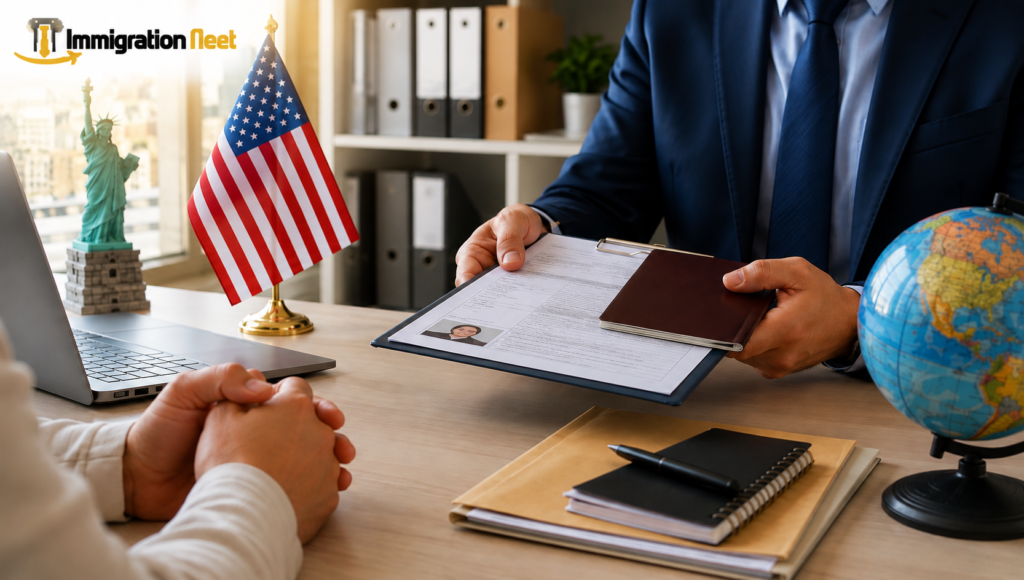
For individuals seeking a U.S. immigrant visa while living outside the United States, consular processing is one of the primary paths to lawful permanent residence. The process involves several government agencies, documentation requirements, fees, background checks, and an interview at a U.S. embassy or consulate.
Understanding how U.S. immigrant visa consular processing works can help applicants prepare properly, avoid unnecessary delays, and respond effectively to requests for additional information. While every case is different, the overall process generally follows a series of predictable steps.
What Is Consular Processing?
Consular processing is the procedure through which an eligible foreign national applies for an immigrant visa at a U.S. embassy or consulate abroad. If the visa is approved, the individual can travel to the United States and seek admission as a lawful permanent resident.
This process commonly applies to people whose family-based or employment-based immigrant visa petitions have been approved and who are residing outside the United States.
Unlike adjustment of status, which allows certain eligible applicants already in the United States to apply for permanent residence without leaving the country, consular processing takes place primarily through the National Visa Center (NVC) and a U.S. embassy or consulate.
Step 1: Immigrant Petition Approval
The process generally begins when a U.S. citizen, lawful permanent resident, or qualifying employer files an immigrant petition with U.S. Citizenship and Immigration Services (USCIS).
For example, family-based immigration may involve Form I-130, while certain employment-based cases may involve Form I-140.
Once USCIS approves the petition, the case may be transferred to the National Visa Center if consular processing is required. Petition approval, however, does not automatically mean that an immigrant visa will be issued. Applicants must still complete the required visa processing steps.
Step 2: National Visa Center Processing
The National Visa Center plays a central role in preparing immigrant visa cases for the interview stage.
The NVC generally provides instructions for paying required fees, submitting the immigrant visa application, completing the Affidavit of Support requirements when applicable, and uploading or submitting supporting documents.
Applicants should carefully review all instructions and make sure their information is accurate and consistent across forms and documents. Missing documents, incorrect information, or incomplete submissions can result in processing delays.
Step 3: Completing Form DS-260
Applicants applying for an immigrant visa through consular processing generally need to complete Form DS-260, Immigrant Visa Application.
The form requests detailed information about the applicant’s identity, family, education, employment, travel history, and background.
Because the information provided can become part of the immigration record, applicants should answer every question truthfully and carefully. Errors or inconsistencies may create complications later in the process.
Step 4: Submitting Civil and Supporting Documents
Applicants must typically provide civil documents and other evidence required for their specific immigration category.
Depending on the case, documents may include birth certificates, marriage certificates, divorce records, police certificates, passports, photographs, and evidence related to the petition or financial sponsorship.
Documents that are not in English may require an appropriate translation under applicable requirements. Applicants should follow the document instructions provided for their specific embassy, consulate, and case.
Step 5: Affidavit of Support
Many family-based immigrant visa applicants must have a qualifying financial sponsor submit an Affidavit of Support.
The purpose of this document is generally to demonstrate that the intending immigrant has adequate financial support and is less likely to become primarily dependent on certain public benefits.
The sponsor may need to provide financial evidence, such as tax documentation and proof of income or assets, depending on the circumstances.
Step 6: Medical Examination
Before the immigrant visa interview, applicants are generally required to complete a medical examination with an authorized physician.
The medical examination must normally be performed by a physician approved by the relevant U.S. embassy or consulate. Applicants should follow the specific instructions provided by the consular post rather than scheduling an examination with an unauthorized medical provider.
The examination may include required vaccinations and other medical assessments under U.S. immigration rules.
Step 7: The Immigrant Visa Interview
The consular interview is one of the most important stages of the immigration visa process.
During the interview, a consular officer reviews the applicant’s eligibility, documentation, background, and circumstances. Applicants should bring the required original documents and follow the embassy or consulate’s interview instructions.
The officer may approve the application, request additional documentation, or determine that further administrative processing is necessary.
Step 8: Visa Approval or Administrative Processing
If the application is approved, the applicant generally receives instructions regarding passport return and visa issuance. The immigrant visa allows the applicant to travel to the United States and request admission.
However, approval of the visa does not guarantee admission at the U.S. border. The applicant must still be inspected by U.S. Customs and Border Protection upon arrival.
Some cases may also require administrative processing after the interview. The length and nature of administrative processing can vary depending on the circumstances.
Common Consular Processing Challenges
Immigrant visa applicants may encounter challenges involving incomplete documentation, financial sponsorship requirements, prior immigration violations, criminal or security issues, medical requirements, or inconsistencies in their immigration history.
Some cases are more complicated than others. Immigration attorney support for consular processing can be particularly valuable when an applicant has a complicated immigration history, prior visa refusals, inadmissibility concerns, or requests for additional evidence.
How Legal Support Can Help
Professional visa legal support can help applicants understand the requirements that apply to their individual circumstances, organize supporting documentation, identify potential issues, and prepare for important stages of the process.
An immigration attorney can also help explain potential inadmissibility concerns, respond to certain government requests, and evaluate available legal options when complications arise.
Because immigration procedures and requirements can change, applicants should rely on current official instructions and qualified legal advice when their circumstances are complex.
Final Thoughts
Consular processing for U.S. immigrant visas involves several stages, beginning with an approved immigrant petition and continuing through NVC processing, the DS-260 application, document submission, medical examination, and consular interview.
Preparing carefully at every stage can help reduce avoidable problems and keep the case moving as efficiently as possible. For applicants facing complicated immigration circumstances, obtaining experienced immigration legal support can provide valuable guidance throughout the process.

 Immigration Fleet Law Firm