
U.S. Citizenship and Immigration Services (USCIS), a component of the Department of Homeland Security (DHS), has introduced important changes affecting Form I-485, Application to Register Permanent Residence or Adjust Status, following recent regulatory and policy updates.
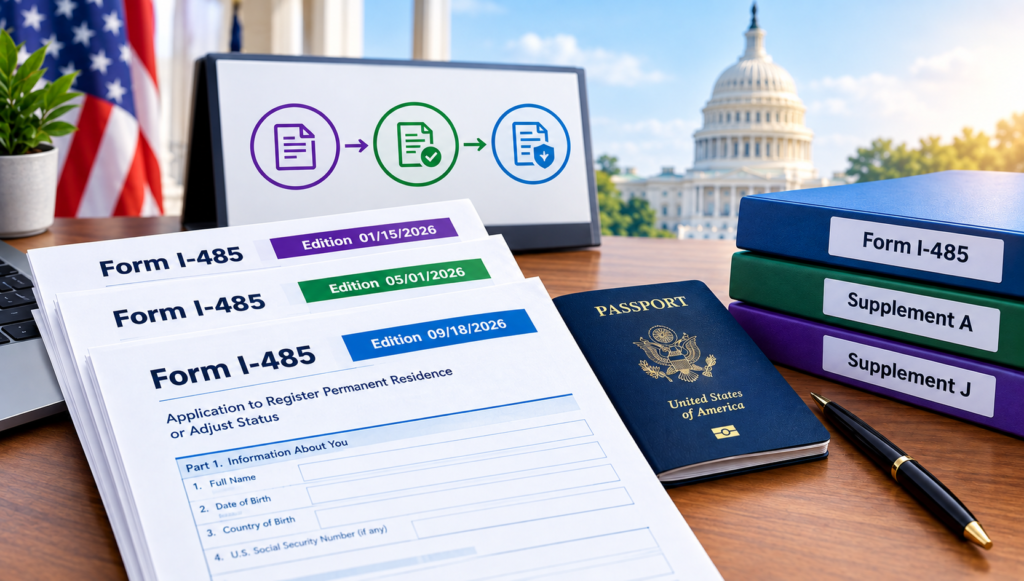
Two developments are particularly important for applicants and attorneys: a new interim final rule concerning certain children born in the United States to foreign government employees and the introduction of new editions of Form I-485 and related supplements effective September 18, 2026.
New Rule for Children of Certain Foreign Government Employees
On September 4, 2026, DHS issued an Interim Final Rule (IFR) that expands the regulatory framework allowing certain children born in the United States to foreign government employees to register as lawful permanent residents.
The rule applies where:
- The child was born in the United States;
- Neither parent is a U.S. citizen; and
- At least one parent was a qualifying foreign government employee when the child was born.
The new rule expands the previous framework, which focused more narrowly on children of foreign diplomatic officers.
Under the amended regulations, the term “foreign government employee” can include certain foreign diplomatic officers accredited to the United States, qualifying employees of foreign embassies or consulates who are nationals of the relevant foreign country, individuals employed by a foreign government in an official capacity, and certain employees of international organizations that have international-organization immunity.
The rule also identifies categories that generally do not qualify. These can include personal employees or attendants of foreign officials, certain employees of state-owned enterprises, third-country nationals working for foreign governments, certain contractors, and foreign government employees who are visiting the United States in a personal capacity.
Updates to Form I-485 and Form G-325R
To implement the regulatory changes, USCIS/DHS is updating Form I-485 and its accompanying instructions.
One notable terminology change replaces the previous reference to “Individuals Born in the United States Under Diplomatic Status” with “Individuals Born to a Foreign Government Employee in the United States.”
DHS is also making corresponding changes to Form G-325R, Biographic Information (Registration). The changes address children born in the United States who do not acquire U.S. citizenship at birth, do not register for permanent residence under the amended process, and may therefore be subject to applicable alien-registration requirements.
The Federal Register rule explains that DHS is extending the existing Form I-485 registration process to additional qualifying children of foreign government employees who do not acquire citizenship at birth.
September 18, 2026: New Form I-485 Edition Becomes Mandatory
A separate and highly important development occurred on September 18, 2026.
USCIS implemented new editions of:
- Form I-485, Application to Register Permanent Residence or Adjust Status
- Form I-485 Supplement A
- Form I-485 Supplement J
According to AILA’s September 14, 2026 practice alert, these new editions take effect on September 18 and no grace period is provided.
This means applicants preparing an adjustment-of-status filing should carefully verify the edition date of each applicable form before submitting the package.
Using an outdated form edition after the mandatory effective date can create a filing problem, including the possibility that USCIS rejects the submission.
Why Multiple Form Editions Matter
Form editions can change when USCIS updates a form to reflect regulatory requirements, revised questions, filing procedures, or other government policies.
The September 2026 changes are particularly significant because they coincide with implementation of a new Public Charge Ground of Inadmissibility final rule.
As a result, applicants should not assume that an older copy of Form I-485 remains acceptable simply because the form appears substantially similar.
Before filing, applicants should confirm:
- The current edition date of Form I-485.
- Whether Supplement A is required for the particular case.
- Whether Supplement J is required.
- That all accompanying forms use the currently accepted editions.
- That the filing package reflects the applicable USCIS requirements on the date of filing.
Effective Date of the Foreign Government Employee Rule
The September 4, 2026 interim final rule applies to qualifying children born on or after the rule’s effective date, while children born before that date are generally treated under the regulations applicable at the time of birth. The Federal Register publication explains that the rule expands the registration process to children born to qualifying foreign government employees where neither parent is a U.S. citizen.
However, implementation is also affected by ongoing litigation involving birthright citizenship.
The legal landscape surrounding Executive Order 14418 and birthright citizenship remains subject to court proceedings. AILA has reported litigation involving challenges to the administration’s birthright-citizenship policies, including class-wide litigation and preliminary injunction proceedings.
Therefore, the practical application of the new rule may depend on the applicant’s circumstances, including the child’s date and place of birth, the parents’ status, and whether the applicant falls within a court-protected class.
What Applicants Should Do
Applicants preparing Form I-485 packages should use particular care during this transition period.
Before submitting an application, review the latest USCIS form editions and instructions, confirm that the applicable form is accepted as of the filing date, and make sure all required supplements and supporting documents are included.
This is especially important because USCIS has recently implemented several form-edition changes without a transition period. AILA has also raised concerns regarding recent mandatory form changes and the absence of grace periods for certain updated forms.
Applicants with cases involving children born to foreign government employees should also review the specific requirements under the September 2026 interim final rule and consider obtaining qualified immigration-law advice where eligibility or court-related issues are unclear.
Conclusion
The September 2026 immigration updates create an important period of transition for Form I-485 applicants.
The new DHS rule expands the regulatory framework for certain children born in the United States to qualifying foreign government employees, while USCIS has simultaneously introduced new editions of Form I-485, Supplement A, and Supplement J.
Because the new form editions became effective on September 18, 2026, without a grace period, applicants should verify the edition date before filing and avoid relying on previously downloaded forms.
Given the interaction between the new regulations, the revised forms, the Public Charge rule, and ongoing litigation concerning birthright citizenship, applicants should evaluate their circumstances carefully and rely on the most current USCIS guidance when preparing an adjustment-of-status filing.




 Immigration Fleet Law Firm