
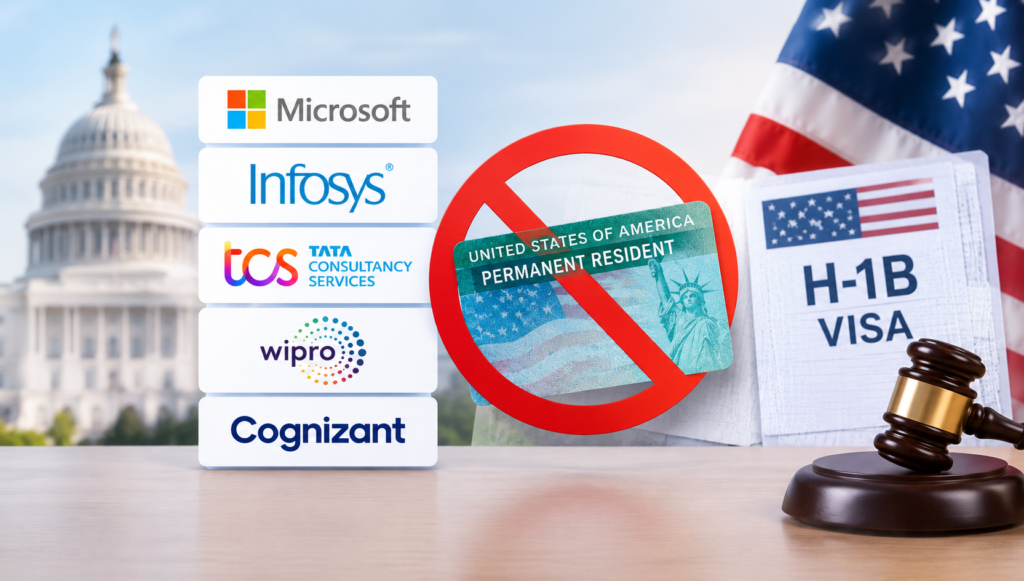
The United States has suspended several major technology companies from a key employment-based green card program amid allegations of misuse of immigration and labor certification procedures. The reported action affects prominent technology and IT services companies, including Microsoft, Infosys, Tata Consultancy Services (TCS), Wipro, and Cognizant, along with Adobe, HCL Technologies, and Capgemini.
Announced on October 8, 2026, the move represents a significant development in US employment-based immigration policy. Federal officials have alleged that certain employers misused visa programs and disadvantaged American workers. The decision could complicate permanent residency sponsorship for foreign professionals employed by the affected companies. Source: India Today.
What Is the US Green Card Program Suspension?
The action concerns the Permanent Labor Certification program, commonly known as PERM, administered by the US Department of Labor. PERM is generally a key step when an employer sponsors a foreign worker for an employment-based green card in a category requiring labor certification.
Under the process, employers typically must demonstrate that there are no sufficient, able, willing, and qualified US workers available for the position and that employing the foreign worker will not adversely affect the wages and working conditions of similarly employed US workers.
According to media reports, Labor Secretary Keith Sonderling announced that the department would stop accepting new PERM applications involving the affected companies and would also halt processing pending applications. The suspensions were announced amid ongoing federal investigations into alleged violations. Source: TechCrunch.
Which Companies Are Affected by the Decision?
The reported suspension covers eight major technology and IT services companies:
- Microsoft
- Adobe
- Cognizant
- Infosys
- Tata Consultancy Services (TCS)
- Wipro
- HCL Technologies
- Capgemini
These companies play significant roles in the US technology sector and employ professionals across software development, cloud computing, consulting, engineering, and other specialized fields.
The suspension could affect employer-sponsored permanent residency cases associated with these organizations. However, allegations of misconduct should not be treated as established findings of wrongdoing against every company. The precise allegations, evidence, and legal outcomes may differ among the organizations.
Why Has the US Government Taken This Step?
The administration has presented the action as part of a broader effort to prioritize American workers and strengthen oversight of employment-based immigration programs.
Vice President JD Vance criticized companies over the alleged displacement of US workers, while Labor Department officials referred to concerns about potential abuse of immigration and labor certification systems.
The government’s concerns include allegations that certain employers may have used foreign-worker programs in ways that undermine domestic employment opportunities or wage protections. These are allegations under investigation, rather than a substitute for company-specific findings or final legal determinations.
Microsoft has disputed the criticism of its immigration practices. The company stated that most of its H-1B applications in the relevant period involved existing employees rather than new hires, according to reporting by News On AIR. Source: News On AIR.
How Does the Suspension Affect H-1B Visa Holders?
The distinction between an H-1B visa and a green card is particularly important.
The H-1B program allows qualifying US employers to employ foreign professionals temporarily in specialty occupations. A green card, by contrast, provides lawful permanent resident status.
The PERM labor certification process is a separate step in many employment-based green card cases. Therefore, suspending an employer’s participation in PERM does not automatically cancel an employee’s existing H-1B status, revoke an existing green card, or terminate employment.
However, affected workers whose permanent residency cases depend on their employer completing PERM may face delays or uncertainty. The consequences for an individual depend on the stage of the case, the applicable immigration category, the worker’s current status, and the scope and duration of the suspension.
Potential Impact on Indian IT Professionals
Indian professionals could be particularly affected because Indian nationals represent a substantial share of workers using the H-1B program and many rely on employer-sponsored immigration pathways.
The reported suspension may create difficulties for employees waiting for their employers to initiate or complete labor certification. Delays can be especially consequential for workers approaching the end of their permitted H-1B stay, although the applicable extensions and other options depend on individual circumstances.
Employees should not assume that their employment authorization has automatically ended. Instead, they should confirm their current status and pending case details with their employer’s immigration team or a qualified US immigration attorney.
What Should Affected Employees and Employers Do?
Employees and employers should take practical steps to understand the scope of the suspension and its potential consequences.
First, workers should obtain a clear update on whether their PERM application has been filed, remains pending, or has already progressed to a later stage. They should distinguish labor certification from subsequent immigrant petition and adjustment-of-status steps.
Second, employers should review official Department of Labor communications and any applicable instructions regarding pending cases, filing restrictions, and possible next steps.
Third, workers approaching the end of their authorized stay should seek individualized legal advice promptly. Depending on their circumstances, an attorney may evaluate potential extensions, alternative immigration classifications, portability rules, or other lawful options. No alternative should be assumed to be available without reviewing the specific facts.
What Happens Next?
The duration and eventual outcome of the suspensions will be important for employers and foreign professionals. Further official information, the progress of investigations, and any legal challenges may clarify how the restrictions will be administered.
Until more details become available, affected workers should rely on official government notices and qualified legal advice rather than social media speculation or assumptions about automatic visa cancellations.
Conclusion
The reported suspension of Microsoft, Infosys, TCS, Wipro, Cognizant, and other major technology companies from the PERM program marks a significant development in US employment-based immigration policy.
Although the action may disrupt green card sponsorship and increase uncertainty for foreign professionals, it does not automatically cancel existing H-1B visas or granted permanent residency. Employees and employers should carefully assess individual cases, monitor official updates, and seek appropriate legal guidance as the situation develops.




 Immigration Fleet Law Firm