
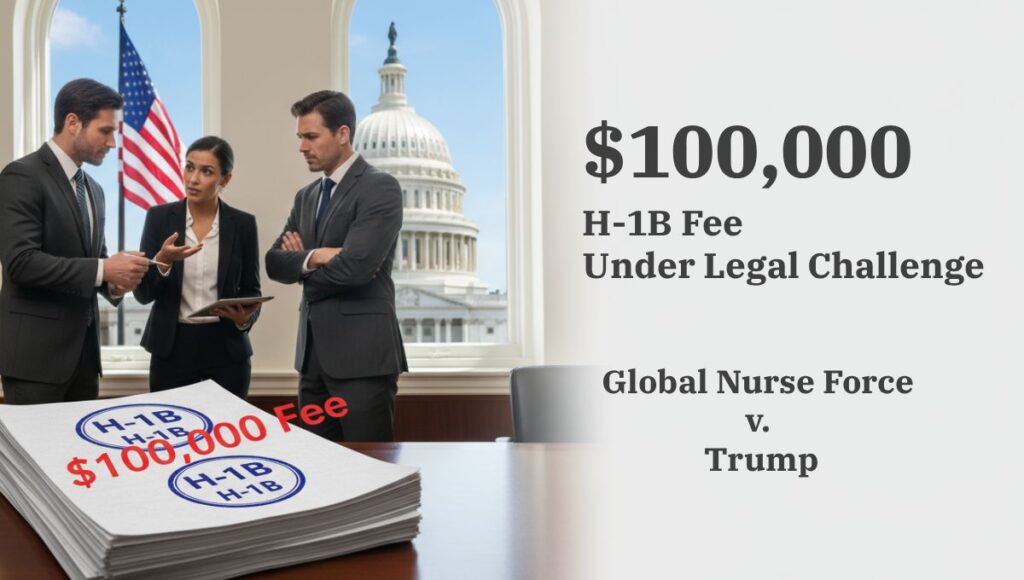
Challenge to the $100,000 H-1B Visa Fee under the September 19, 2025 Proclamation
Introduction
On October 3, 2025, a coalition of healthcare institutions, labor unions, educational organizations, and faith-based entities filed a federal lawsuit in the United States District Court for the Northern District of California. The suit challenges the constitutionality and legality of a presidential proclamation issued on September 19, 2025, by President Donald J. Trump, which imposes a $100,000 entry fee on all new H-1B visa applicants seeking admission to the United States.
The plaintiffs argue that this executive action, which significantly alters the financial and legal landscape of the H-1B visa program, exceeds presidential authority, violates administrative law, and undermines congressional powers under the U.S. Constitution. The case is captioned Global Nurse Force et al. v. Donald Trump et al., Case No. 3:25-cv-08454.
This article provides a comprehensive legal analysis of the proclamation, the nature of the lawsuit, the underlying statutory and constitutional arguments, and the broader implications for U.S. immigration law, public interest institutions, and the separation of powers doctrine.
Background of the Proclamation
A. Summary of the September 19, 2025 Executive Action
The proclamation, titled “Preserving American Wages and Innovation through Economic Safeguards,” imposes a $100,000 non-refundable fee on foreign nationals seeking admission to the United States in H-1B non-immigrant status. It was issued pursuant to Sections 212(f) and 215(a) of the Immigration and Nationality Act (INA), which grant the President authority to suspend or restrict the entry of noncitizens if deemed detrimental to U.S. interests.
Effective September 21, 2025—just two days after its announcement—the fee applies to all new H-1B petitions filed for individuals outside the United States. It does not, as clarified by subsequent DHS guidance, apply to existing H-1B visa holders or extensions for those currently in the U.S.
While the administration claims the measure is designed to prioritize high-skilled, high-wage workers and deter “abuse” of the H-1B program, critics argue that it effectively bars access to foreign professionals in sectors such as healthcare, education, and religious ministry, which are already facing acute labor shortages.
The Plaintiffs and Their Standing
The plaintiffs comprise a broad spectrum of entities directly impacted by the proclamation, including:
- Global Nurse Force, a healthcare staffing organization recruiting international nurses;
- Religious organizations employing foreign ministers and clergy;
- K-12 and postsecondary schools reliant on foreign-language teachers and STEM faculty;
- Labor unions representing healthcare and educational workers;
- Public interest immigration groups, such as the Justice Action Center.
They argue they are suffering imminent, concrete harm from the new policy, including:
- Cancelled or delayed hiring of essential personnel;
- Disruption of healthcare delivery in medically underserved regions;
- Financial and operational burdens from the abrupt fee implementation;
- Violation of existing employment contracts and visa strategies.
Their standing is supported by direct injuries traceable to the proclamation, fulfilling the three-prong constitutional test for Article III jurisdiction: injury-in-fact, causation, and redressability.
Legal Claims Raised in the Complaint
The plaintiffs assert three primary legal claims against the proclamation.
Violation of the Administrative Procedure Act (APA), 5 U.S.C. § 551 et seq.
The plaintiffs argue that the government’s implementation of the $100,000 fee is procedurally invalid under the APA, due to the following:
- Lack of Notice and Comment:
The fee was enacted without advance publication or public comment, bypassing rulemaking procedures required for substantive regulatory changes. - Arbitrary and Capricious Standard:
The administration failed to reasonably explain the necessity for such an exorbitant fee, ignored less burdensome alternatives, and neglected to assess the economic harm to healthcare systems, schools, and non-profits. - No “Good Cause” Exception Justified:
The expedited implementation (within 36 hours of issuance) does not meet the APA’s narrow exception for emergencies or urgent public interest actions.
The APA violation claim is central to invalidating the proclamation’s operational effect.
B. Ultra Vires Action under the Immigration and Nationality Act
The complaint alleges that the proclamation exceeds the President’s statutory authority under the INA, particularly:
- Section 212(f) authorizes the President to suspend entry of noncitizens if their admission would be detrimental to U.S. interests. However, this power has historically been used to bar entry based on national security or public health—not to impose financial barriers or rewrite the visa structure authorized by Congress.
- Section 215(a) allows the President to regulate the departure and entry of noncitizens, but not to impose financial conditions that effectively operate as taxation or legislative override.
The plaintiffs argue that nowhere in the INA is the President granted authority to impose an entirely new fee structure on non-immigrant visa applicants, especially one of such magnitude.
C. Violation of the U.S. Constitution – Separation of Powers and Appropriations Clause
This argument centers on the Constitutional doctrine of separation of powers:
- Congressional Power of the Purse:
Under Article I, Section 8, Congress has exclusive authority to levy taxes, impose fees, and allocate federal revenue. By unilaterally mandating a $100,000 fee, the President is accused of unlawfully encroaching upon Congress’s fiscal authority. - Nondelegation Doctrine:
Even if the INA granted broad discretion, the plaintiffs contend that such discretion cannot be interpreted to authorize the executive to establish substantial revenue mechanisms absent clear congressional intent. - Due Process and Equal Protection:
The sudden imposition of a prohibitively high fee, with no clear waiver criteria or transition period, may violate the Fifth Amendment by depriving affected individuals and organizations of fair notice and equal treatment under law.
Immediate Relief Sought
The plaintiffs have filed for:
- A preliminary injunction to halt enforcement of the fee while litigation proceeds;
- A declaratory judgment that the proclamation and related guidance are unlawful;
- A permanent injunction barring the federal government from implementing or enforcing the $100,000 fee for any H-1B applicants.
The request for expedited relief is grounded in the risk of irreparable harm, particularly to hospitals and schools that depend on timely hiring of foreign professionals.
Legal and Policy Implications
A. Impacts on Healthcare and Education
This fee disproportionately affects sectors that are not “Big Tech,” which is often the political target in H-1B debates. Many hospitals rely on foreign nurses, especially in rural or underserved areas. Similarly, schools with dual-language immersion programs or STEM curricula often depend on H-1B teachers.
The inability to pay this fee could result in unstaffed positions, higher patient-to-provider ratios, and reduced access to quality education, especially in low-income communities.
B. Broader Executive Authority in Immigration
This case tests the limits of presidential power under INA §§ 212(f) and 215(a). The Supreme Court has upheld broad authority under 212(f) in cases like Trump v. Hawaii (2018), but courts have also placed limits when executive action lacks a clear national interest justification or invades congressional turf.
A ruling in favor of plaintiffs could significantly restrict future presidents from using proclamations to unilaterally reshape legal immigration programs. Conversely, a decision upholding the fee could signal near-limitless discretion under 212(f), with wide-ranging consequences for non-immigrant visa systems.
Conclusion
The lawsuit Global Nurse Force et al. v. Donald Trump et al. represents a crucial legal test of both the substance and the process of executive immigration policy. At its core, the case asks:
- Can the President impose a six-figure financial barrier to lawful entry without legislative approval?
- Does expedited executive action escape judicial review under the APA?
- And what are the constitutional limits—if any—on presidential proclamations impacting immigration and revenue?
The outcome of this case will not only determine the fate of thousands of skilled workers and the institutions that depend on them, but it may also define the contours of presidential authority over immigration in the decades to come.




 Immigration Fleet