
Introduction
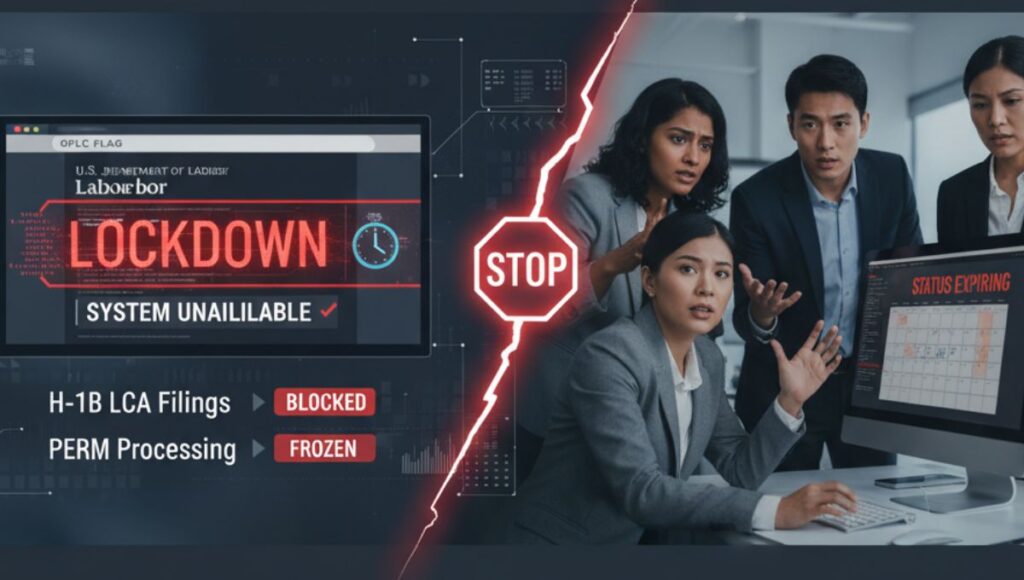
Government shutdowns are not merely fiscal events; they have tangible legal and procedural consequences within the immigration landscape. When the U.S. Department of Labor (DOL) ceases operations due to lapse in appropriations, the statutory and regulatory ecosystem governing H-1B, PERM Labor Certification, and Prevailing Wage Determinations (PWDs) is effectively paralyzed.
The DOL Office of Foreign Labor Certification (OFLC) serves as the gatekeeper for essential employer attestations that underpin both temporary non-immigrant (H-1B) and permanent immigrant (PERM-based green card) filings. Therefore, a DOL shutdown suspends the legal machinery of employment-based immigration, producing cascading effects across multiple stages of petition processing.
This article examines the legal framework, regulatory impact, and strategic considerations employers must understand, written in a manner consistent with formal legal commentary.
Statutory and Regulatory Framework
A. Labor Condition Application (LCA) — H-1B Non-immigrant Process
- Governing Law:
- Immigration and Nationality Act (INA) § 212(n), codified at 8 U.S.C. § 1182(n).
- Implementing regulations: 20 C.F.R. § 655.700–§ 655.760.
- Legal Requirement:
Before filing Form I-129 with U.S. Citizenship and Immigration Services (USCIS), an employer must secure a certified LCA (Form ETA-9035) from the DOL attesting to compliance with wage levels, working conditions, and notice obligations. - Dependency:
The H-1B process cannot proceed without a certified LCA. During a DOL shutdown, the Foreign Labor Application Gateway (FLAG) portal becomes inaccessible, freezing certification submissions and halting H-1B petition pipelines.
B. PERM Labor Certification — Employment-Based Green Card
- Governing Law:
- 8 U.S.C. § 1182(a)(5)(A) (labor certification requirement).
- Implementing regulations: 20 C.F.R. Part 656.
- Procedural Steps:
- Prevailing Wage Determination (PWD) under 20 C.F.R. § 656.40.
- Recruitment and Filing of ETA-9089 (PERM Application).
- Legal Impact:
Both the prevailing wage request and PERM application depend entirely on DOL systems. A shutdown stops adjudications, tolls recruitment timelines, and delays the ability to establish a priority date—a critical marker under 8 C.F.R. § 204.5(d) for future immigrant visa eligibility.
C. Other Affected Processes
- H-1B1 and E-3 applications (requiring LCAs under similar regulations).
- H-2A/H-2B temporary labor certifications (governed by 20 C.F.R. Parts 655, 656).
- E-Verify (administered by DHS but dependent on DOL wage data and inter-agency verification).
Legal Consequences of a DOL Shutdown
A. Suspension of Statutory Filings
When appropriations lapse, the Antideficiency Act (31 U.S.C. § 1341) prohibits agencies from obligating funds absent congressional authorization. As a result, DOL personnel responsible for immigration certifications are legally barred from processing LCAs, PWDs, or PERM applications.
Thus, from a statutory perspective, no “deemed filed” status exists for petitions attempted during shutdown unless DOL expressly issues guidance allowing retroactive validation.
B. H-1B Impact: Filing and Status Maintenance
- New or Amended H-1B Petitions
Employers cannot file an H-1B petition without a valid certified LCA. As per 8 C.F.R. § 214.2(h)(4)(i)(B)(1), USCIS requires the LCA as a prerequisite. - Extension of Status
Employees nearing the expiration of H-1B status may be forced into legal uncertainty if a new LCA cannot be obtained before filing. Although 8 C.F.R. § 274a.12(b)(20) provides limited automatic extension rights, those provisions do not extend to situations where the employer is unable to timely file due to DOL closure. - Extraordinary Circumstances Exception
In prior shutdowns, USCIS has exercised discretion under 8 C.F.R. § 214.1(c)(4) (late extension filings for good cause). Employers should preserve detailed documentation showing that the delay was caused solely by DOL’s unavailability.
C. PERM Impact: Prevailing Wage and Certification Timelines
- Prevailing Wage Requests (PWDs):
Pursuant to 20 C.F.R. § 656.40(b), the employer must obtain a valid prevailing wage determination prior to initiating recruitment. When the DOL’s FLAG system is down, PWD requests cannot be filed or adjudicated. - Recruitment Timelines:
Employers in the midst of recruitment may find their 180-day recruitment validity window (20 C.F.R. § 656.17(e)) expiring during the shutdown. Absent specific DOL guidance tolling the timeframe, such recruitment may need to be re-initiated, adding months of delay. - Filing of PERM (ETA-9089):
No new filings, audit responses, or corrections can be submitted during the shutdown. The statutory priority date—established on the date of proper filing—cannot be secured until the agency reopens, delaying subsequent Form I-140 filings under 8 C.F.R. § 204.5(k).
D. E-Verify and I-9 Compliance
- E-Verify Suspension: The DHS-managed E-Verify system becomes unavailable, excusing employers temporarily from initiating new cases. However, obligations under INA § 274A(b) (I-9 verification) remain intact.
- Employers should annotate the I-9 record noting system unavailability and complete E-Verify queries retroactively once service resumes.
Post-Shutdown Legal Realities
When DOL resumes operations, a significant case backlog accumulates. Under Administrative Procedure Act (5 U.S.C. § 555(b)), agencies must conclude matters “within a reasonable time,” but historical precedent demonstrates months-long recovery periods.
A. Resubmission Protocols
DOL typically issues Federal Register or OFLC notices providing grace periods for late filings. Employers should carefully follow those directives, citing the shutdown as an equitable tolling circumstance recognized under federal administrative law.
B. Documentation for USCIS
H-1B filings delayed by the shutdown should include:
- Screenshots or notices showing FLAG unavailability;
- Dated internal correspondence demonstrating readiness to file;
- Legal memorandum citing 8 C.F.R. § 214.1(c)(4) as basis for nunc pro tunc consideration.
Employer Compliance and Risk Management
1. Pre-emptive Filings
When congressional funding lapses appear imminent, employers should expedite submission of LCAs and PWDs. Early filing mitigates potential bottlenecks.
2. Maintain Contemporaneous Evidence
In anticipation of discretionary relief, preserve all evidence showing attempts to comply during the shutdown—system error logs, email confirmations, or screenshots from FLAG.
3. Workforce Continuity Planning
Develop contingency plans for employees whose non-immigrant status may expire during shutdown. Alternatives may include change of status filings or remote placement in non-U.S. jurisdictions until certification resumes.
4. Counsel Coordination
Corporate counsel should synchronize immigration, HR, and payroll departments to ensure legal compliance and maintain a unified record trail in case of future DOL or USCIS audits.
Practical Takeaways
- No LCA, no H-1B. Filing cannot legally proceed until DOL reopens.
- PERM pipelines freeze. Recruitment windows and PWD clocks stop.
- Prepare for backlog. Expect a surge once DOL resumes, extending adjudication timelines.
- Preserve proof. Document all attempted filings for future discretionary consideration.
- Monitor Federal Register guidance. DOL generally issues reopening notices with filing relief periods.
Conclusion
The Department of Labor serves as the regulatory cornerstone of employment-based immigration. A shutdown halts not only agency operations but also the legal rights of employers and foreign nationals dependent upon those certifications.
In the absence of legislative appropriations, no legal mechanism compels DOL to process or accept filings, creating statutory paralysis across the H-1B and PERM ecosystems. Employers must respond not reactively, but with foresight—filing early, maintaining evidence, and invoking available regulatory relief to protect both compliance and continuity.



 Immigration Fleet