
I. Introduction
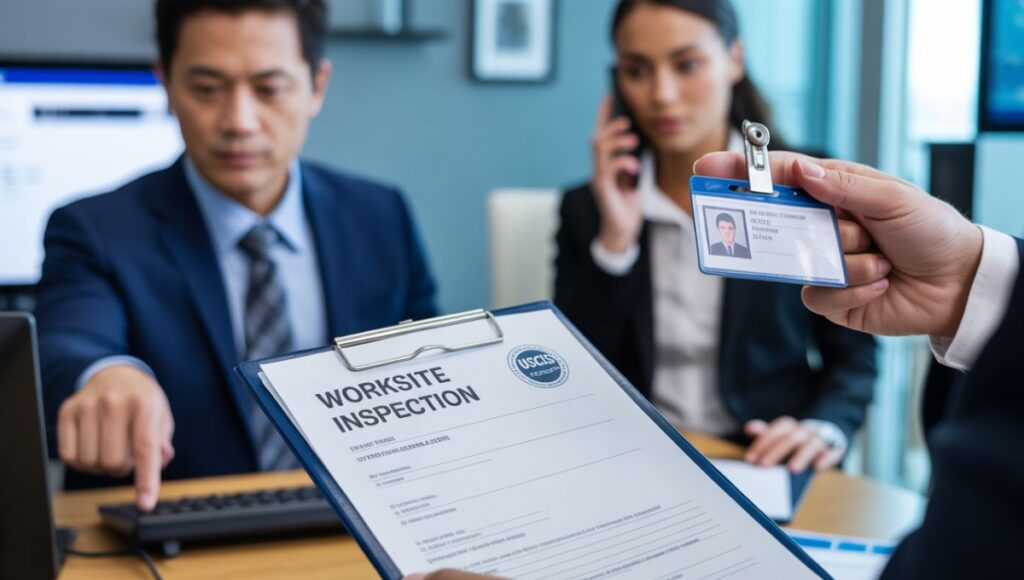
In recent years, the U.S. Citizenship and Immigration Services (USCIS), through its Fraud Detection and National Security (FDNS) Directorate, has intensified its worksite inspection and compliance verification program. These site visits, often unannounced, are intended to ensure that employers and employees are adhering to the terms of approved H-1B, L-1, and other non-immigrant petitions.
While the stated objective is fraud prevention, in practice, site visits are legal audits—testing whether employers maintain bona fide operations, accurate job representations, and valid employer–employee relationships under 8 C.F.R. § 214.2(h).
Proper handling of these visits is critical. A poorly managed site inspection can lead to petition revocations, compliance investigations, or future denials. This article outlines the legal framework, inspection procedures, and practical guidance for employers and employees to handle site visits confidently and lawfully.
Legal and Regulatory Framework
| Legal Source | Scope |
| INA § 214(c)(1) | Authorizes USCIS to enforce terms of non-immigrant petitions. |
| 8 C.F.R. § 214.2(h)(2)(i)(E) | Requires employers to file amended petitions for material changes in employment. |
| Neufeld Memorandum (Jan. 8, 2010) | Defines employer–employee relationship for H-1B compliance. |
| FDNS Site Visit Procedures (USCIS 2010 Directive) | Authorizes unannounced inspections to verify petition accuracy. |
| 20 C.F.R. § 655.730–.760 | DOL’s LCA compliance and employer recordkeeping requirements. |
FDNS inspectors are empowered to verify, through in-person interviews and documentation review, that the employment conditions described in the petition match the reality of the worksite.
Nature and Purpose of USCIS Site Visits
FDNS officers conduct random and targeted inspections to ensure:
- The employer is a bona fide operating entity;
- The foreign national is employed at the location specified in the petition;
- The job duties and wages match the approved LCA; and
- There exists a valid employer–employee relationship, particularly in third-party placement scenarios.
Typically, these visits are unannounced and last between 30 to 90 minutes. The officer will arrive with government identification, introduce themselves as an FDNS contractor or USCIS officer, and request to meet the employer’s representative or the H-1B employee.
What Happens During a Site Visit
A. Employer Verification
- Officer may request to meet a manager, HR representative, or company signatory listed on the petition.
- Verification includes reviewing:
- The company’s address and physical operations.
- Payroll and tax records.
- The employee’s job title, duties, and salary.
- Copies of the LCA, I-129 petition, and support documents.
B. Employee Interview
- The officer will usually interview the foreign worker to confirm:
- Current job title and responsibilities.
- Supervisor’s name and reporting hierarchy.
- Work location and salary.
- Awareness of the petitioning employer and contractual structure.
C. Worksite and Equipment Inspection
- Officers may take photographs of the workspace to confirm authenticity of operations and seating arrangements.
V. Employer Responsibilities During Site Visits
1. Verify Officer Identity
Always request to see and copy the officer’s identification. FDNS officers will have official DHS/USCIS credentials. Contractors (such as those from the firm USIS or DISA Global) carry letters of authorization.
2. Notify Legal Counsel
Immediately contact your immigration counsel before providing documents or conducting interviews. Counsel may participate by phone or in person, depending on availability.
3. Designate a Point of Contact
Employers should have a designated compliance officer or HR manager trained to handle FDNS inquiries. Untrained staff should not provide ad-hoc responses.
4. Provide Limited and Accurate Information
Respond only to the questions asked. Do not speculate or provide informal statements about pending petitions or unrelated employees. Misstatements—even accidental—can be construed as material misrepresentation under INA § 212(a)(6)(C)(i).
5. Preserve Confidential Records
You are not required to surrender confidential client contracts or proprietary financial data without a formal subpoena. Offer summaries or redacted documents if necessary.
Employee Guidelines During a Site Visit
1. Stay Calm and Courteous
The officer’s presence is not necessarily an accusation. Site visits are routine compliance checks. Respond professionally and honestly.
2. Be Accurate and Consistent
Ensure answers align with the petition details—especially job title, duties, salary, and work location. Inconsistencies can raise red flags.
3. Know Who You Work For
Employees should clearly identify the petitioning employer, not the end client. The officer’s main concern is verifying who exercises control over the employee’s work.
4. Avoid Over-Disclosure
If uncertain about a question, it is acceptable to say, “I am not sure; I can check with HR.” Avoid guessing or providing speculative answers.
Common Red Flags During FDNS Inspections
- Employee Not Present at Listed Worksite
- Violates LCA representation and may trigger a compliance audit.
- Inconsistent Job Duties
- If the role differs substantially from the approved petition, USCIS may find a “material change” requiring an amended filing under Matter of Simeio Solutions, 26 I&N Dec. 542 (AAO 2015).
- Wage Discrepancies
- Paying less than the certified wage violates 20 C.F.R. § 655.731 and can lead to back-wage liability.
- Unclear Employer–Employee Relationship
- Especially in IT consulting arrangements, failure to demonstrate control over work assignments and supervision may result in revocation.
After the Site Visit
1. Document the Visit
Immediately prepare a written memorandum summarizing:
- Date and time of inspection,
- Officer’s name and credentials,
- Questions asked and answers provided, and
- Any documents shared.
This record can be invaluable if future issues arise.
2. Follow Up in Writing
If the officer requested additional documents, submit them through your counsel within the specified timeline. Avoid direct communication without legal oversight.
3. Conduct Internal Review
Post-visit, review the accuracy of all pending petitions, LCAs, and employee data. If discrepancies are discovered, consult counsel about filing amendments or corrective actions.
Preventive Compliance Practices
- Maintain Updated Public Access Files (PAF) under 20 C.F.R. § 655.760.
- Audit I-129 petitions and LCAs regularly.
- Train managers and employees on immigration compliance awareness.
- Ensure all worksites are listed and covered by active LCAs.
- Centralize immigration documentation to ensure consistent responses during inspections.
Conclusion
USCIS site visits are a lawful component of the government’s integrity verification program. They are not punitive in nature but can have serious repercussions if handled improperly. Employers and employees who are well-prepared—armed with accurate records, consistent answers, and a clear understanding of their legal obligations—can navigate inspections confidently and maintain compliance.
The best defense against compliance risks is proactive preparation. Maintaining transparency, legal oversight, and detailed documentation ensures that when FDNS knocks on the door, the organization can respond with confidence and full compliance under the law.



 Immigration Fleet