
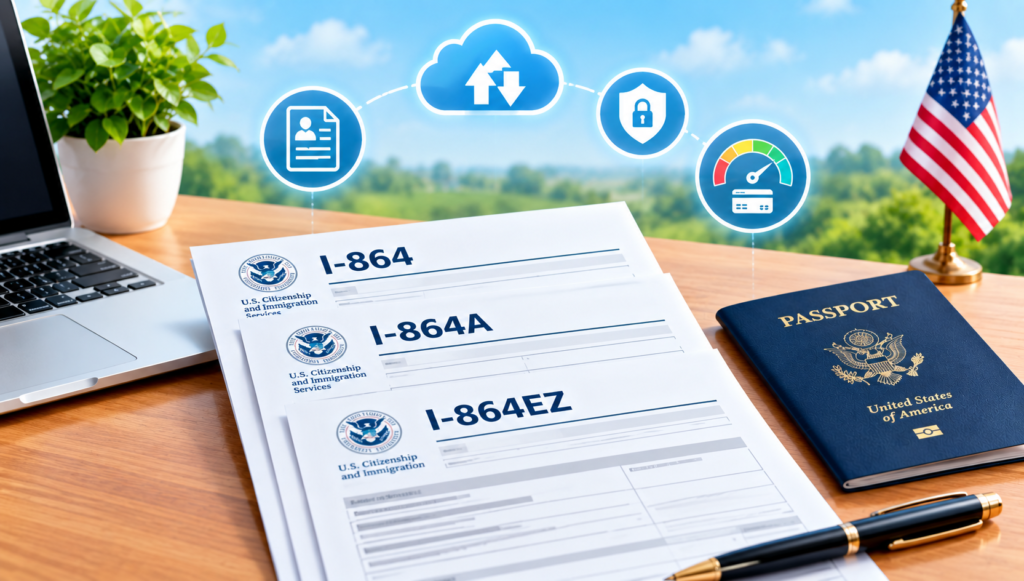
New I-864, I-864A and I-864EZ Forms: What Sponsors Need to Know
U.S. Citizenship and Immigration Services (USCIS) has introduced revised editions of Forms I-864, Affidavit of Support Under Section 213A of the INA, I-864A, Contract Between Sponsor and Household Member, and I-864EZ, Affidavit of Support Under Section 213A of the INA. The revised forms carry an edition date of 08/24/26 and were published on August 31, 2026. The rollout initially called for immediate use of the new editions, but following litigation, USCIS provided a 30-day transition period. The 08/24/26 editions become mandatory for submissions made on or after October 1, 2026.
The update is important because the revised forms contain an express privacy release authorizing USCIS to request information from consumer reporting agencies. The change gives the government a new source of financial information when evaluating an Affidavit of Support. At the same time, USCIS has not announced a minimum credit score that a sponsor must meet, and the revised forms do not establish a standalone credit-score threshold for sponsorship.
Key Filing Deadline for the New I-864 Forms
The transition period creates two important filing windows:
- Through September 30, 2026: USCIS accepts both the 10/17/24 and 08/24/26 editions under the announced grace period.
- Starting October 1, 2026: the 08/24/26 editions are required. USCIS will not process the older 10/17/24 editions when they are postmarked or electronically submitted on or after October 1.
For practitioners and applicants, the practical approach is to transition to the current editions as soon as possible rather than relying on an older form that is close to the deadline. The edition date should be checked on every page of the form before submission.
What Changed in the 08/24/26 Editions?
The most significant change is the addition of an explicit privacy release related to consumer reporting information. By signing the revised declaration, the sponsor or qualifying household member authorizes USCIS to request information from one or more consumer reporting agencies. The updated language is also relevant to Form I-864A and Form I-864EZ.
USCIS has also warned that a credit or security freeze may prevent a consumer reporting agency from releasing information needed for its review. If a sponsor has a freeze in place, USCIS may be unable to obtain the information it needs to evaluate the Affidavit of Support. Sponsors should therefore be prepared to respond promptly if USCIS asks them to release a freeze.
Does the New Form Create a Minimum Credit Score?
No minimum credit score has been announced in the materials discussed above. The revised form adds authorization for consumer-report information, but it does not state that a particular credit score is required for a sponsor to qualify. Likewise, USCIS has not published a detailed scoring system explaining how individual items such as debt, late payments, collections or bankruptcy would affect an Affidavit of Support determination.
This distinction is important. A credit report and a credit score are not the same thing. A credit score is calculated using a scoring model and information contained in a consumer credit report. Different scoring models can produce different scores. Sponsors should avoid assuming that one score, by itself, determines whether an Affidavit of Support is sufficient.
Income and Asset Requirements Remain Central
The new form editions do not announce a new income threshold. The Affidavit of Support framework continues to rely on the statutory and regulatory requirements governing a sponsor’s income and, where applicable, assets. In general, sponsors must demonstrate the means to maintain the intending immigrant at the applicable percentage of the Federal Poverty Guidelines, subject to the rules and exceptions that apply to the particular case.
If a sponsor cannot meet the applicable income requirement, the immigration process may permit the use of qualifying assets, a household member’s contribution through Form I-864A, or a joint sponsor, depending on the circumstances. The revised privacy release adds another source of financial information; it does not by itself replace the existing income and asset framework.
How the Change Relates to Public Charge Review
The Affidavit of Support and the public charge inadmissibility analysis are related but distinct parts of the immigration process. USCIS’s updated public charge guidance identifies financial circumstances among the factors that may be considered in the totality of the circumstances. The USCIS framework also identifies the sponsor’s ability to support the applicant as relevant, including sponsor income and assets and certain negative financial circumstances.
Because USCIS has not published detailed adjudication standards explaining how consumer-report information obtained under the new I-864 privacy release will be weighed, practitioners should be cautious about drawing conclusions from a single negative credit-report item or credit score. A negative item should not automatically be treated as an independent ground for denial without considering the governing requirements and the facts of the individual case.
Credit Freezes and Filing Preparation
A security or credit freeze restricts access to a consumer’s credit file. Under USCIS’s warning, such a freeze may interfere with a consumer-report request connected to the Affidavit of Support. Sponsors who maintain a freeze should understand how to temporarily lift or release it if USCIS requests access.
Before filing, sponsors and qualifying household members can review their credit-report status and discuss any potential issues with qualified immigration counsel. Credit reports are available through the nationwide consumer reporting agencies and through authorized consumer-reporting resources. Reviewing the information in advance can also help identify outdated or inaccurate information that may need attention.
LexisNexis and Other Financial or Public-Record Information
Separate from the consumer-report authorization in the revised forms, immigration practitioners have reported attention to broader financial and public-record databases in immigration adjudications. AILA materials discussing Department of State practices have referenced LexisNexis reports in connection with Affidavit of Support sponsors. Such databases can contain categories of information beyond a traditional credit score, potentially including property records, liens, judgments, bankruptcy records, vehicle information, professional licensing data, historical addresses and other public-record information.
However, the precise scope, frequency and adjudicative use of such reports by USCIS or the Department of State should not be assumed unless confirmed by agency guidance or case-specific information. Practitioners should distinguish documented agency statements from reported practices and unresolved questions.
Practical Tips for Sponsors and Immigration Practitioners
- Use the 08/24/26 edition of Forms I-864, I-864A and I-864EZ for submissions on or after October 1, 2026.
- Check the edition date on every page before filing and avoid relying on saved copies of older forms.
- Ask sponsors and qualifying household members whether a credit or security freeze is active.
- If a freeze is active, understand the procedure for releasing it promptly if USCIS requests access.
- Review current income, assets, tax documentation and household-size calculations before submitting the Affidavit of Support.
- Consider reviewing the sponsor’s credit report and financial records with qualified counsel where appropriate.
- Do not assume that a particular credit score automatically qualifies or disqualifies a sponsor; USCIS has not published a minimum score standard.
- Monitor USCIS and Department of State guidance for further clarification about how consumer-report information will be evaluated.
- If an older form is improperly rejected during the applicable transition period, preserve the filing evidence and consider raising the issue through appropriate practitioner or agency channels.
What Sponsors Should Do Now
Sponsors preparing family-based immigrant visa or adjustment-of-status filings should treat the form edition as an important filing-control item. The safest preparation step is to download the current forms directly from USCIS, verify the 08/24/26 edition date, review the financial documentation, and determine whether a credit or security freeze could interfere with a consumer-report request.
The practical impact of the new privacy release will become clearer as USCIS and the Department of State apply the revised forms and issue additional guidance. Until then, sponsors and practitioners should separate confirmed requirements from unanswered questions and avoid treating a credit score alone as a definitive measure of Affidavit of Support eligibility.
Conclusion
The 2026 revisions to Forms I-864, I-864A and I-864EZ introduce an important new privacy authorization for consumer-report information and create additional preparation considerations for financial sponsors. The 30-day transition period means the 08/24/26 editions are required for submissions beginning October 1, 2026. Sponsors should review the new forms carefully, check for credit or security freezes, organize income and asset evidence, and monitor future USCIS and Department of State guidance as the agencies clarify how the new financial information will be used.




 Immigration Fleet Law Firm