
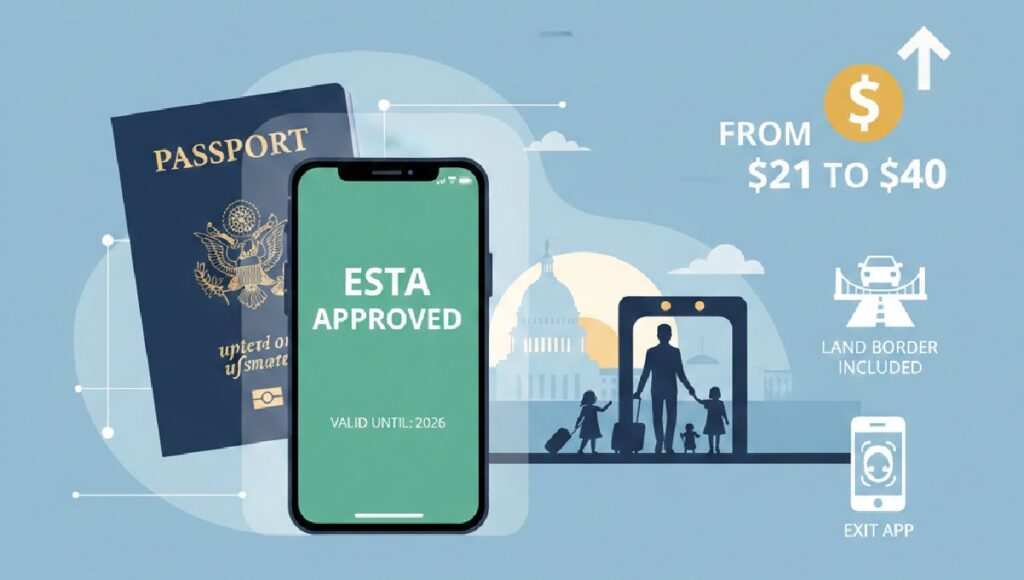
The Electronic System for Travel Authorization (ESTA) is a mandatory pre-screening mechanism used by most travellers entering the United States under the Visa Waiver Program (VWP). Although ESTA has long been a core element of VWP travel, recent fee adjustments, policy clarifications, and data-collection initiatives highlight the importance of understanding evolving compliance obligations.
This legal update summarizes the current ESTA framework, reviews recent developments, and outlines best-practice recommendations for travellers and organizations supporting international mobility.
Overview of ESTA
ESTA is administered by the U.S. Department of Homeland Security (DHS) through U.S. Customs and Border Protection (CBP). It allows eligible nationals from VWP-participating countries to seek entry to the United States for tourism or business purposes for up to 90 days without first obtaining a visa.
Applicants submit biographic information and security-related responses online, enabling CBP to conduct a pre-departure risk assessment. CBP advises applicants to obtain ESTA approval as early as possible in the trip-planning process and no later than 72 hours prior to departure.
Importantly, ESTA authorization does not guarantee admission to the United States. It merely permits boarding and travel to a U.S. port of entry. Final admissibility determinations are made by CBP officers at the border.
Increase in ESTA Application Fees
Effective September 30, 2025, the ESTA filing fee increased from $21 to $40.
The revised fee applies to:
- All new ESTA filings, and
- Renewals submitted on or after the effective date.
Applicants should apply only through the official CBP ESTA website to avoid inflated third-party service charges.
Revisions to Information Collection
In a notice published December 10, 2025, CBP announced plans to revise data collection requirements associated with:
- ESTA submissions, and
- Form I-94 Arrival/Departure Records.
Public comments were invited regarding the necessity, scope, and impact of the proposed data elements. These initiatives reflect DHS’s ongoing efforts to strengthen screening accuracy, national security protections, and immigration-compliance monitoring.
ESTA Requirements for Land Border Entry
Historically, ESTA was explicitly required only for air and sea travel under the VWP. However, CBP guidance issued October 1, 2022 indicates that ESTA authorization is also expected for Visa Waiver travelers entering the United States by land, unless exempted by specific current guidance.
Given that some public-facing materials still emphasize air and cruise travel, the conservative legal approach is as follows:
Any traveler seeking entry under the Visa Waiver Program — whether arriving by air, sea, or land — should obtain an approved ESTA before traveling, unless CBP or U.S. Embassy guidance expressly indicates otherwise for their specific situation.
This approach minimizes the risk of travel disruption, denial of boarding, or refusal of admission.
I-94 Records and Departure Confirmation
Most foreign nationals are issued an electronic Form I-94 upon entry, which records both date of admission and authorized period of stay. CBP integrates I-94 records with passport, ESTA, and carrier manifest data into its Arrival and Departure Information System (ADIS) to maintain accurate entry-exit histories.
The December 10, 2025 Federal Register notice also describes a voluntary mobile-app departure validation pilot program. Participating travelers may confirm exit by submitting:
- Passport details
- A live facial image
- Location information
Where verification is successful, the system records a confirmed departure, which may be useful in demonstrating lawful compliance. Participation is optional and failure to use the app does not constitute a violation.
Key Compliance Considerations
Travelers should ensure that they:
- Obtain ESTA authorization prior to travel
- Understand that ESTA does not guarantee entry
- Depart within the permitted 90-day period
- Monitor official CBP updates before each trip
- Retain travel documentation in case of future verification needs
Overstays under the Visa Waiver Program may result in serious and lasting immigration consequences, including loss of VWP eligibility.
Immigration Fleet Law Firm Advisory and Recommendations
Immigration Fleet advises Visa Waiver Program travelers, corporate mobility teams, and compliance departments to proactively prepare for ESTA-related developments and maintain documentation consistent with DHS expectations. We recommend the following:
1. Apply Early and Use Official Systems
Submit ESTA applications well before anticipated travel, preferably at the planning stage. Avoid third-party intermediaries unless legally necessary.
2. Verify Eligibility and Travel Purpose
Ensure the intended activity clearly qualifies under business or tourism permitted under the VWP. Travelers engaging in employment or extended stays should seek legal guidance regarding alternative visa classifications.
3. Maintain Accurate Travel Records
Retain itineraries, proof of timely departure, and I-94 records to support future immigration applications or inspection inquiries.
4. Monitor Policy Updates
CBP guidance evolves. Immigration Fleet recommends periodic review of policy changes — especially regarding land-border travel and data collection.
5. Seek Legal Counsel Where Uncertainty Exists
Travelers with prior visa refusals, overstays, arrests, or complex travel histories should obtain legal advice before traveling, as ESTA approval may be denied or revoked.
Conclusion
ESTA remains a cornerstone of the Visa Waiver Program, and recent regulatory developments — including fee increases, data-collection updates, expanded land-border applicability, and optional exit-confirmation processes — reinforce the importance of advance planning and strict compliance with CBP procedures. Travelers and organizations should remain proactive to ensure lawful and uninterrupted travel to the United States.
Immigration Fleet remains available to advise travelers and employers on ESTA compliance, Visa Waiver eligibility, entry preparation, and broader U.S. immigration obligations.




 Immigration Fleet