
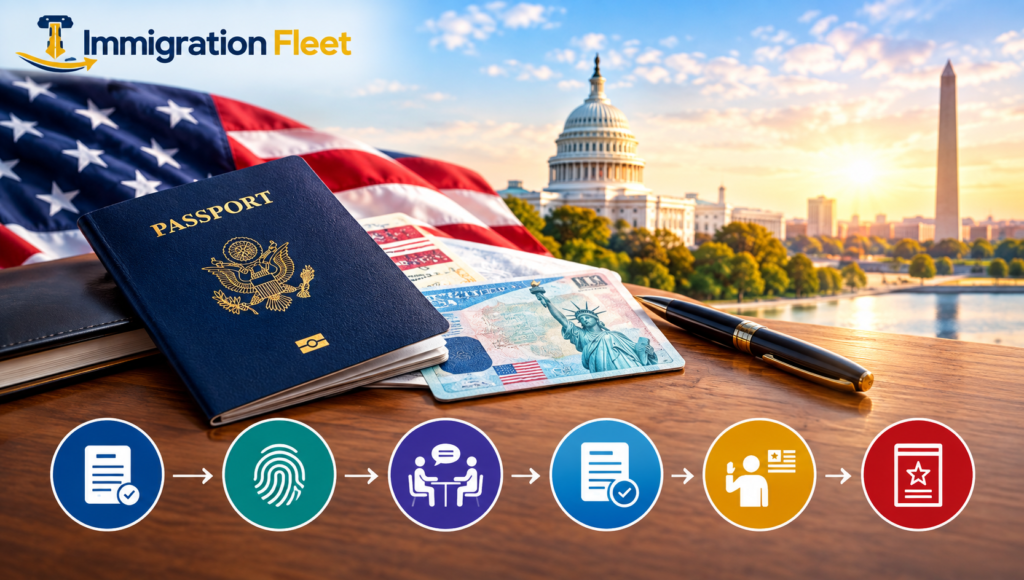
Becoming a U.S. citizen through naturalization is an important milestone for many lawful permanent residents. One of the most common questions applicants have is: How long does U.S. citizenship take?
The answer depends on several factors, including when you become eligible, where your Form N-400 is processed, the complexity of your case, interview scheduling, and the timing of your naturalization ceremony. USCIS reported a national median processing time of 7.1 months for standard Form N-400 applications in Fiscal Year 2026 through June 30, 2026. This is a historical median rather than a guarantee for an individual application.
Understanding each stage can help applicants plan ahead and avoid unnecessary delays.
When Can You Apply for U.S. Citizenship?
Most lawful permanent residents become eligible for naturalization after maintaining permanent resident status for at least five years. Certain applicants married to and living with a U.S. citizen may qualify under the three-year rule if they meet the applicable requirements.
USCIS generally allows eligible applicants to file Form N-400 up to 90 calendar days before completing the required three- or five-year continuous-residence period. Applicants must still satisfy the other naturalization requirements when they file.
Before filing, applicants should review requirements related to continuous residence, physical presence, good moral character, English and civics requirements, and residence within the applicable USCIS jurisdiction.
Step 1: Preparing and Filing Form N-400
The naturalization process begins with preparing and submitting Form N-400, Application for Naturalization.
Applicants should carefully complete the form and provide the required information and supporting documentation. Errors, incomplete answers, missing information, or filing before eligibility requirements are met can create complications.
USCIS recommends reviewing the application carefully before submission and keeping the mailing address current throughout the process.
Once USCIS receives the application, the applicant receives a receipt notice that confirms the case has been accepted for processing.
Step 2: Biometrics and Background Checks
After filing, USCIS may schedule the applicant for a biometrics appointment. Depending on the case, USCIS may require fingerprints, a photograph, and a signature.
The fingerprints are used for background checks. USCIS provides appointment information when biometrics are required.
Not every applicant will necessarily experience this stage in exactly the same way, so applicants should follow the instructions provided by USCIS.
Step 3: Naturalization Interview
The naturalization interview is one of the most important stages of the process.
During the interview, a USCIS officer reviews the applicant’s Form N-400 and asks questions about the application and background. Eligible applicants generally also take the required English and civics tests unless an applicable exemption or waiver applies.
Applicants should bring the documents listed in their interview notice and be prepared to discuss information provided in their application.
Interview scheduling can vary significantly depending on the USCIS field office handling the case.
Step 4: USCIS Decision
After the interview, USCIS may approve the application, continue processing it, request additional information, or take another action permitted under the applicable rules.
If USCIS needs additional evidence or information, responding accurately and within the specified timeframe is important. Requests for additional evidence or other case-specific issues can extend the overall timeline.
USCIS processing times are estimates based on historical case completion data and can change over time. Applicants should therefore check the official USCIS processing-time tool for the field office handling their application.
Step 5: Oath of Allegiance and Certificate of Naturalization
Approval of Form N-400 does not by itself make the applicant a U.S. citizen.
The applicant must complete the Oath of Allegiance at a naturalization ceremony. USCIS states that an applicant becomes a U.S. citizen after taking the Oath of Allegiance. Following the ceremony, the applicant receives a Certificate of Naturalization.
The ceremony may be scheduled after approval, although the timing can vary depending on the location and available ceremony dates.
How Long Does the Entire Naturalization Process Take?
There is no single guaranteed timeline for every applicant. As a useful current reference, USCIS reported a 7.1-month national median processing time for standard N-400 cases in FY 2026 through June 30, 2026. Military naturalization cases had a separate FY 2026 median of 3.0 months.
Importantly, a national median should not be interpreted as a guaranteed completion time. Half of cases in the relevant historical dataset were completed within the median timeframe and half took longer. Processing can vary based on the field office, case circumstances, requests for additional information, interview scheduling, and other factors.
What Can Cause Naturalization Delays?
Several issues may affect how quickly an application moves forward:
- Incorrect or incomplete information on Form N-400
- Filing before meeting eligibility requirements
- Complicated travel or continuous-residence history
- Delays in responding to USCIS requests
- Additional background or security checks
- Interview rescheduling
- Field-office workload and appointment availability
- Changes in personal information or address during processing
Applicants should monitor their USCIS case status and respond promptly to official notices.
Missing a scheduled interview can also create delays. USCIS advises applicants who cannot attend their scheduled interview to follow the instructions for requesting a rescheduling.
How Can Applicants Prepare for a Smoother Process?
Careful preparation can help reduce avoidable problems. Applicants should first determine whether they meet the applicable naturalization requirements. They should then review their travel history, address history, employment information, immigration history, and other details before submitting Form N-400.
Preparing for the English and civics portions of the naturalization process is also important. Applicants should review the USCIS study materials and understand what documents they need to bring to the interview.
Most importantly, applicants should rely on the current USCIS requirements and processing-time information rather than assuming that another applicant’s timeline will be the same.
Conclusion
So, how long does U.S. citizenship take? For many applicants, the process can take several months after filing Form N-400, but the exact timeframe depends on individual circumstances and the USCIS field office processing the application. The FY 2026 national median for standard N-400 cases was 7.1 months through June 30, 2026.
Understanding the major stages—from eligibility and N-400 filing to biometrics, interview, decision, and the Oath of Allegiance—can help applicants plan more effectively. Checking USCIS processing times and following each notice carefully can also help applicants stay informed throughout the naturalization journey.




 Immigration Fleet Law Firm