Immigration Fleet

Continuous Residence Requirement for U.S. Naturalization Explained

For many lawful permanent residents, becoming a U.S. citizen through naturalization is an important milestone. One of the key eligibility requirements is continuous residence in the United States. This requirement is designed to show that an applicant has maintained the United States as their principal place of residence during the required statutory period. Understanding how

Continuous Residence Requirement for U.S. Naturalization Explained Read More »

Removing Conditions on Permanent Residence (Form I-751): A Comprehensive Legal Analysis Under U.S. Immigration Law

Conditional permanent residence occupies a distinct place within the framework of United States immigration law. Although an individual granted conditional permanent resident status possesses many of the same rights and privileges as any other lawful permanent resident, Congress intentionally imposed additional statutory requirements to ensure that immigration benefits obtained through marriage are based upon a

Removing Conditions on Permanent Residence (Form I-751): A Comprehensive Legal Analysis Under U.S. Immigration Law Read More »

Employment-Based Green Cards Through Consular Processing: What Applicants Need to Know

Obtaining a U.S. employment-based green card through consular processing is a multi-stage immigration process for eligible foreign nationals who are outside the United States. Unlike adjustment of status, which allows eligible applicants already in the United States to apply for permanent residence without leaving the country, consular processing involves completing immigrant visa processing through the

Employment-Based Green Cards Through Consular Processing: What Applicants Need to Know Read More »

USCIS Asylum Rule Reform: Administrative Efficiency vs. Due Process

Executive Summary The U.S. asylum system stands at a critical juncture, caught between the operational demands of processing an unprecedented administrative backlog and the constitutional obligation to provide fair, individualized adjudications. Recent regulatory reforms introduced by the Department of Homeland Security (DHS) and U.S. Citizenship and Immigration Services (USCIS)—including the Interim Final Rule authorizing direct

USCIS Asylum Rule Reform: Administrative Efficiency vs. Due Process Read More »

LEGAL BRIEFING: H-1B SPECIALTY OCCUPATION EDUCATIONAL REQUIREMENTS & DEGREE FIT

Executive Summary To successfully secure an H-1B non-immigrant visa classification, a petitioning employer must prove that the offered position qualifies as a specialty occupation under Section 214(i)(1) of the Immigration and Nationality Act (INA). While recent administrative updates have reshaped selection mechanisms (including wage-weighted lottery allocations) and fee structures, United States Citizenship and Immigration Services

LEGAL BRIEFING: H-1B SPECIALTY OCCUPATION EDUCATIONAL REQUIREMENTS & DEGREE FIT Read More »

L-2 Visa for Spouses and Children: Work Authorization & Status Explained

The L-2 visa allows eligible spouses and unmarried children of certain L-1 nonimmigrant workers to accompany or join the principal visa holder in the United States. Understanding L-2 status, work authorization, and dependent rights is important for families planning to live and work in the U.S. Who Qualifies for an L-2 Visa? L-2 status is

L-2 Visa for Spouses and Children: Work Authorization & Status Explained Read More »

The Future of H-1B Immigration After the Judicial Suspension of the $100,000 Fee

Executive Summary The legal landscape governing high-skilled business immigration underwent a profound shift following federal court orders that enjoined and vacated the mandatory $100,000 fee requirement for certain H-1B non-immigrant worker petitions. Originally promulgated by Presidential Proclamation in September 2025, the fee represented an unprecedented cost increase designed to curb reliance on foreign labor. Following

The Future of H-1B Immigration After the Judicial Suspension of the $100,000 Fee Read More »

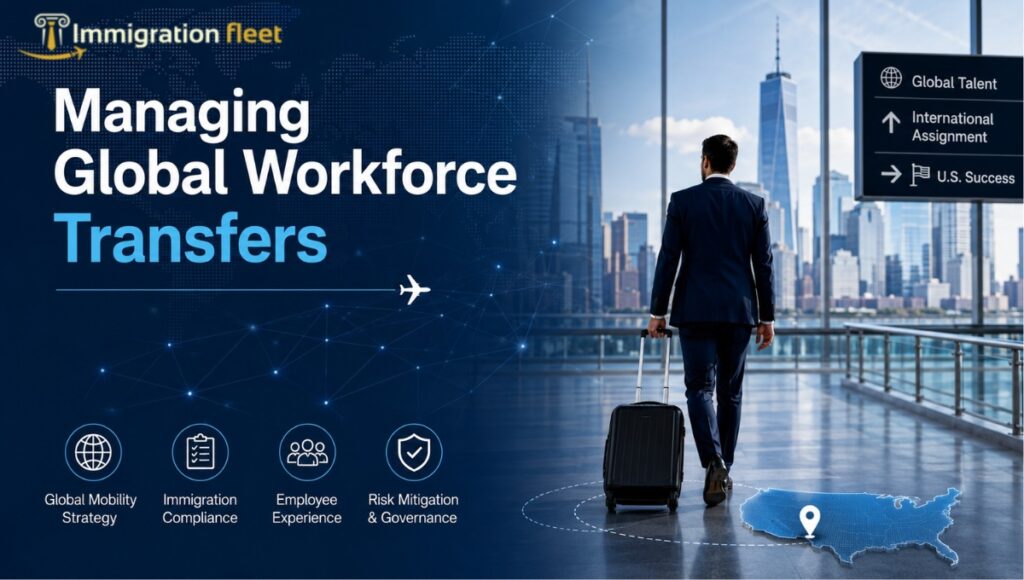
Managing Global Workforce Transfers: A Guide to U.S. Immigration Compliance

Global workforce transfers allow businesses to move skilled employees across international offices while supporting growth, specialized projects, and business continuity. However, transferring employees to the United States requires careful planning to ensure compliance with U.S. immigration and employment requirements. A structured corporate immigration strategy can help employers reduce delays, compliance risks, and operational disruptions. Global

Managing Global Workforce Transfers: A Guide to U.S. Immigration Compliance Read More »

Marriage-Based Green Card Process Under U.S. Immigration Law: A Comprehensive Legal Guide

Marriage to a United States citizen or a lawful permanent resident may provide a pathway to lawful permanent residence (commonly referred to as obtaining a “Green Card”). However, approval is not automatic upon marriage. Under the Immigration and Nationality Act (INA), applicants must establish both statutory eligibility and admissibility, while demonstrating that the marriage was

Marriage-Based Green Card Process Under U.S. Immigration Law: A Comprehensive Legal Guide Read More »